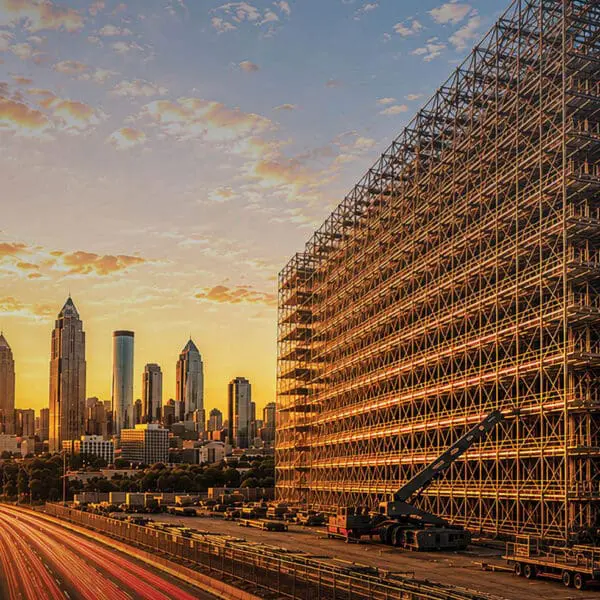
Heavy-duty high-bay racking systems engineered by Andes Industrial Racking S.A.S.
High-Density Storage · Structural Engineering · Global Procurement

Next-Generation Industrial Racking: Engineered for Seismic Safety and Autonomous Warehousing

Delivering high-performance racking, dynamic automated shuttle storage, and custom steel structures designed to maximize cubic density and lower Total Cost of Ownership (TCO).

Engineering Insight

Why Racking Structural Integrity Defines Modern Logistics Success

In an era of global supply chain volatility and soaring industrial real estate costs, industrial racking has evolved from basic steel shelving into sophisticated structural engineering infrastructure. Andes Industrial Racking S.A.S. designs, manufactures, and installs certified high-density racking systems engineered to meet international structural codes (including EN 15512, RMI, and seismic standard NSR-10).

Whether optimizing fulfillment centers in North America, Latin America, Europe, or Asia, selecting the ideal racking architecture requires balancing floor slab point-loads, SKU throughput velocity, rack frame stiffness, and micro-climate environmental resistance. Our multi-tier racking and automated shuttle frameworks allow supply chain directors to unlock up to 85% greater vertical storage capacity compared to legacy floor-stacking techniques.

Certified EN 15512 & FEM 10.2.02 Standards NSR-10 & ASCE 7 Seismic Compliance Cold-Formed High-Tensile Steel Profiles Turnkey Engineering & Inspection Support
Industrial Racking Portfolio

Engineered Racking Solutions for Every Logistics Application

Explore our flagship industrial racking product lines. Each system is custom-engineered using Finite Element Analysis (FEA) to match your specific SKU profile, handling equipment, and building geometry.

Direct Access

Selective Pallet Racking

The universal baseline for flexible distribution centers. Designed with heavy-duty cold-rolled steel uprights and adjustable beam connectors, offering 100% direct pallet selectivity.

Key Features: Beams adjustable every 50mm, high load capacity up to 4,500kg per beam level, compatible with all forklift types.

Detailed Specs
Heavy & Long Loads

Cantilever Racking Systems

Engineered without front upright columns to safely store long, continuous, or bulky material such as steel pipes, timber packs, structural profiles, and aluminum extrusions.

Key Features: Freestanding columns up to 12 meters high, load-tested dynamic cantilever arms, indoor or outdoor galvanized powder coatings.

Detailed Specs
Vertical Space Multiplication

Heavy-Duty Mezzanine Platforms

Transform unused overhead vertical height into usable floor space for order picking, assembly lines, or additional storage without costly facility expansions.

Key Features: Column spans up to 10 meters, floor deck loads up to 2,000 kg/m², integrated staircases and pallet drop safety gates.

Detailed Specs
High-Density Picking

Small Goods Racking & Shelving

Modular shelving architectures optimized for hand-loaded items, spare parts handling, and high-velocity e-commerce split-case picking operations.

Key Features: Multi-tier walkway integration, carton live storage flow beds, pick-to-light sensor readiness.

Detailed Specs
Automated High-Density

2D Pallet Shuttle Racking

Semi-automated and fully automated deep-lane shuttle racking designed for maximum cubic utilization, cold-storage energy retention, and rapid LIFO/FIFO throughput.

Key Features: Sub-zero operational capability (-30°C), autonomous lithium-powered shuttles, seamless WMS integration.

Automation Details
Custom Consultation

Need a Custom-Engineered Layout?

Our structural engineers calculate rack bay loads, sway resistance, baseplate dimensions, and slab anchor specifications tailored to your precise warehouse building geometry.

Manufacturing & Global News

Global Reach, State-of-the-Art Production Capabilities

Andes Industrial Racking S.A.S. manufacturing facility expansion
Global Manufacturing

240,000 Sq Ft Advanced Production Plant Expands Racking Supply Across the Americas

Our state-of-the-art manufacturing plant in Calhoun, Georgia (USA) represents our 8th global production center. Featuring automated roll-forming lines, robotic welding bays, and eco-friendly powder coating systems, this facility boosts production speed and drastically reduces lead times for racking projects throughout North and South America.

Strategic Integration of Automated Pallet Shuttles and AMR Autonomous Picking Robots

Combining heavy-duty racking frames with Movu-robotics shuttle platforms enables enterprise buyers to scale warehouse throughput without expanding building footprint.

Advanced FEA Structural Simulation for Seismic-Resistant High-Bay Racking

Our structural engineering division updates seismic design parameters under NSR-10 and EN 15512 codes to guarantee operational safety in active seismic zones worldwide.

Market Intelligence

Supply chain leaders and procurement executives are shifting from unit-price purchasing to long-term lifecycle evaluation. Discover the five major trends shaping global racking procurement.

1. Strict Seismic & Structural Compliance

Logistics operators now prioritize rigorous seismic structural calculations over generic off-the-shelf racking. High-density zones require custom baseplate engineering, anchor embedment depth verifications, and frame sway bracing tailored to local seismic codes (such as NSR-10 in Colombia and ASCE 7 in North America).

2. Cold-Chain High-Density Optimization

With refrigerated warehouse energy costs climbing, enterprise buyers are replacing traditional selective racking with automated shuttle racking systems. High-density storage reduces refrigerated cubic air space per pallet position, cutting power consumption by up to 40%.

3. AMR & Shuttle-Ready Rack Structures

Modern racking infrastructure is built to accommodate future automation upgrades. Buyers select racking profiles engineered with integrated guidance rails, sensor targets, and ultra-flat tolerance beams capable of supporting Autonomous Mobile Robots (AMRs) and automated bin systems without structural retrofitting.

4. Nearshoring & Local Manufacturing Speed

Global logistics disruptions have made domestic and nearshore manufacturing lead times a top procurement metric. With 8 manufacturing facilities globally (including plants in Europe and the Americas), Andes Industrial Racking S.A.S. guarantees predictable delivery timelines and standardized structural steel grade consistency.

5. Sustainable Steel & ESG Procurement Standards

Corporate ESG targets mandate low-carbon steel manufacturing, non-toxic powder coating processes, and recyclable structural components. Racking systems are now benchmarked by their embodied carbon footprint and long-term structural reusability.

6. Total Cost of Ownership (TCO) Prioritization

Procurement teams evaluate racking on long-term durability, reduced rack upright repair frequency, and safety compliance rather than initial purchase price. High-tensile steel components lower repair downtime and maintain resale/reconfiguration value over decades of operation.

Technology Outlook

How technological innovation is turning passive steel racking frames into intelligent, self-monitoring storage infrastructure.

01

IoT Structural Health Monitoring

Future racking installations feature embedded IoT strain gauges, optical deflection sensors, and impact detection micro-transmitters. These smart sensors alert warehouse managers in real time to forklift collisions or localized over-loading, preventing structural collapse before dynamic failure occurs.

02

Rack-Supported Building (Silo Systems)

The traditional warehouse is evolving: high-bay clad-rack automated buildings (Silos) use the industrial racking framework as the primary load-bearing structural support for the facility's roof and side walls. Rising to heights over 40 meters, Silo systems eliminate the need for separate structural steel building columns.

03

Advanced Anti-Corrosion Surface Coatings

Nanotechnology-enhanced thermosetting powder coatings and continuous Sendzimir hot-dip galvanization techniques allow industrial racking to endure highly aggressive environments—from coastal saline humidity to chemical processing facilities—extending structural lifespan beyond 25 years with minimal maintenance.

Andes Industrial Racking S.A.S. at a Glance

2000+

Global Employees

8

Advanced Manufacturing Plants

€1.0Bn+

Annual Group Revenue

60+

Countries Served

Engineering Rigor

Critical Site Engineering Considerations for Global Racking Projects

A high-performance rack layout requires far more than arranging upright frames. Our structural engineering team evaluates four essential site parameters to guarantee maximum safety and long-term durability.

Seismic Hazard Zoning

Active seismic zones demand specialized racking design parameters under codes such as NSR-10 and EN 15512. Baseplate anchors, dynamic sway bracing, and column profile gauge thickness are customized per local ground acceleration data.

Atmospheric Humidity & Salinity

Logistics centers located near coastal ports or high-humidity regions require heavy galvanized steel finishes, stainless steel floor anchors, and anti-corrosion protective coatings to resist rapid structural oxidation.

High Land Cost & Free Trade Zones

In high-cost logistics corridors and trade zones (Zonas Francas), expanding footprint outward is financially inefficient. Building upward with multi-tier mezzanines and high-bay racking maximizes cubic return on capital.

Cold Chain & Thermal Efficiency

Temperature-controlled flower, produce, pharmaceutical, and frozen food storage facilities rely on dense shuttle racking to decrease air volume turnover, preserving refrigeration power consumption.

Industrial racking manufacturing excellence by Andes Industrial Racking S.A.S.
Corporate Responsibility

Leading the Industrial Storage Industry in ESG & Decarbonization

At Andes Industrial Racking S.A.S., engineering innovation goes hand-in-hand with environmental stewardship. Our global ESG program is actively reducing carbon emissions across every stage of structural steel fabrication and project installation.

From solar-powered manufacturing plants to low-emission waterway transport routes, we help corporate logistics procurement teams achieve their scope 3 carbon reduction objectives.

Green Initiatives

Our ESG Milestones in Action

We combine heavy-duty steel engineering with sustainable manufacturing practices to lower total environmental impact across global logistics supply chains.

2028 Target100% Electric Commercial Service Fleet
7,000+Rooftop Solar Panels Operating on Main Plants
Waterway FreightMultimodal Transport Reducing Road Carbon Footprint
How do you calculate structural safety factors for industrial racking under seismic loads?
Structural engineering for industrial racking in seismic regions relies on Finite Element Analysis (FEA) calibrated to local seismic building codes (such as NSR-10 in Colombia, ASCE 7 in the USA, or EN 15512 / FEM 10.2.02 in Europe). Structural engineers compute localized ground acceleration parameters, concrete floor slab anchor shear resistance, frame buckling moments, and horizontal pallet movement dynamics. Rather than selecting catalog components, upright profiles, beam connections, and sway bracing are specified specifically for the site's seismic risk profile.
What is the operational ROI difference between selective pallet racking and automated shuttle racking?
Selective pallet racking offers lower upfront capital expenditure (CapEx) and 100% direct access to every pallet, making it ideal for high-SKU operations. Automated 2D pallet shuttle racking, by contrast, eliminates forklift operating aisles to increase storage density by 60% to 80%. For high-volume, low-SKU applications, cold-storage distribution centers, or industrial areas with elevated real estate costs, automated shuttle racking typically delivers operational payback within 18 to 30 months through labor reduction, fleet savings, and reduced energy consumption.
How does atmospheric humidity and coastal saline climate dictate racking material specifications?
Warehouses situated near coastal ocean ports or in humid tropical climates face high atmospheric salinity, accelerating surface rust and steel degradation. Standard interior powder coatings may develop micro-porosity over time. Engineering best practice mandates specifying pre-galvanized (Sendzimir) steel profiles, hot-dip galvanized components for outdoor structural cantilever racks, stainless steel floor anchor bolts, and specialized thermosetting epoxy-polyester coatings tested under 1,000+ hours of continuous salt spray fog exposure.
What engineering data must procurement teams submit to receive an optimized racking proposal?
To generate an accurate structural quote and CAD layout, our engineering team requires: (1) Facility building DWG drawings showing clear height under roof trusses, column grids, and floor obstacle locations; (2) Concrete slab specification (thickness, compressive strength in MPa, mesh reinforcement, and flatness tolerances); (3) Pallet load specifications including weight, dimensions (width x depth x height), and load overhang; (4) SKU velocity profiles and target daily pallet throughput; (5) Forklift model specifications or operational aisle width requirements; and (6) Project city location for seismic zoning analysis. Please email project details to [email protected].
Can existing selective pallet racking frames be converted into an automated shuttle system?
In some cases, upright frames can be re-engineered if structural load ratings allow for deep-entry support brackets. However, converting selective racking into an automated shuttle or Autonomous Mobile Robot (AMR) system typically requires replacing conventional beam levels with specialized high-precision shuttle guidance rails, safety stops, and centering devices. A formal engineering structural audit by Andes Industrial Racking S.A.S. is required to verify column capacity, baseplate anchor shear resistance, and floor slab flatness before retrofitting automation technology.