Featured Industrial Push Back & High-Density Racking Systems
Explore our certified heavy-duty warehouse racking solutions, engineered for severe structural stability and high pallet turnover.
Push Back Racking Systems: Strategic Technical Analysis & Enterprise Procurement Guide
An exhaustive technical briefing on low-friction nested cart mechanics, kinetic gravity flow dynamic modeling, seismic resilience, and total cost of ownership (TCO) optimization for modern distribution hubs.
In the current landscape of global supply chain management, logistics leaders and warehouse operations executives face an intense double constraint: maximizing storage density per square meter while minimizing pick cycle times and operating overhead. As urban industrial real estate acquisition costs climb and cold storage energy costs surge, conventional selective pallet racking often falls short due to excessive aisle space demands. Drive-in racking, while dense, frequently introduces operational bottlenecks, severe honeycomb inventory loss, and heightened structural damage risks caused by forklift entry.
Push back racking systems represent the ultimate hybrid engineering solution. Combining high-density Last-In, First-Out (LIFO) storage mechanics with single-aisle accessibility, push back racking utilizes inclined structural steel rails and a series of low-friction nested carts. This comprehensive whitepaper explores the physical, structural, and financial dimensions of push back racking systems, providing procurement teams and logistics directors with actionable insights to evaluate, specify, and deploy this dynamic storage architecture.
Key Engineering Insight: Unlike standard drive-in racking where forklifts must enter the structural frame—increasing damage risk by up to 65%—push back racking maintains forklift movement exclusively in the main access aisle. Loading and unloading take place against gravitational inclination, protecting structural uprights and accelerating pallet cycle velocity by up to 40%.
1. Kinematic Mechanics & Structural Architecture
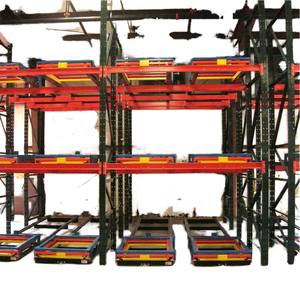
The mechanical core of a push back racking system lies in its inclined nested cart design. Steel carts travel along inclined structural tracks mounted to heavy-duty upright frames at a precisely calculated gradient (typically between 1.5% and 3% inclination, depending on pallet profile and mass distribution). The foundational operation follows a precise physical sequence:
1. Initial Pallet Placement
The forklift operator places the first pallet directly onto the top nested cart positioned at the front aisle edge. The cart is secured by mechanical front stops to prevent unintended displacement.
2. Push-Back Force Mechanics
When inserting the second pallet, the driver gently pushes the first pallet backward using the weight of the incoming unit, exposing the secondary nested cart resting directly beneath.
3. Gravitational Unloading
During retrieval, removing the front pallet allows remaining pallets to roll forward smoothly under gravity, controlled by safety dampers and heavy-duty precision wheel bearings.
Engineered push back systems can be designed from 2-deep to 6-deep pallet configurations per lane. The nested cart mechanism ensures that lower carts sit seamlessly inside upper carts when fully empty, preserving vertical clearance and maximizing the structural clear height of the warehouse bay.
2. Comparative Engineering & Performance Matrix
To understand why push back racking consistently yields superior ROI for medium-SKU, high-volume operations, consider the engineering trade-offs between leading high-density storage technologies:
| Storage Metric | Push Back Racking | Drive-In Racking | Pallet Shuttle (AS/RS) | Selective Racking |
|---|---|---|---|---|
| Storage Density | High (75%–85%) | Very High (85%+) | Maximum (90%+) | Low (50%–60%) |
| SKU Selectivity | Moderate (Lane Level) | Poor (Block Level) | High (Programmed) | 100% Direct Access |
| Handling Velocity | Fast (~2.5 mins/pallet) | Slow (~4.5 mins/pallet) | Very Fast (Automated) | Fast (~2.0 mins/pallet) |
| Forklift Damage Risk | Extremely Low (Aisle Only) | Severe (Inside Frame) | Low (Aisle Only) | Moderate |
| Cold Storage Fit | Excellent (No Electrics) | Good | Requires Special Batteries | Standard |
| CAPEX / Position | Moderate - Balanced ROI | Low Initial Cost | High CAPEX | Lowest Initial CAPEX |
3. Strategic Procurement & Future Industry Development Trends (2026–2030)
As automated material handling and intelligent warehouse software evolve, push back racking systems are undergoing major technological transformations. Procurement managers must design systems not merely for immediate storage capacity, but for dynamic integration with emerging logistics trends:
A. Hybrid Integration with Autonomous Mobile Robots (AMRs) & Automated Guided Vehicles (AGVs): Modern push back systems are increasingly manufactured with high-precision front stops, laser reflection targets, and standardized cart alignments to interface seamlessly with vision-guided automated forklifts. The absence of complex electrical components within the rack lanes makes push back racking an exceptionally robust target for AGV drop-off and pickup operations.
B. Cold Chain Thermal Densification: With global cold storage demands expanding rapidly across pharma and perishable food sectors, energy optimization is paramount. Push back racking allows facilities operating at cold storage temperatures (down to -30°C) to reduce overall cubic air volume needing refrigeration by up to 40% compared to selective racking, drastically cutting operational energy bills without relying on sensitive electrical shuttle batteries susceptible to thermal degradation.
C. High-Tensile Eco-Steel & Advanced Anti-Corrosion Coatings: Advanced manufacturing utilizes high-tensile cold-rolled and hot-rolled structural steel profiles that reduce total steel weight while maintaining structural safety factors under seismic loads (conforming to EN 15512, FEM 10.2.02, and NSR-10 seismic criteria). Advanced electrostatic powder coatings and hot-dip galvanized cart tracks ensure maintenance-free performance in humid coastal logistics hubs and high-moisture processing plants.
4. Enterprise Manufacturing Superiority & Quality Assurance
When partnering with our manufacturing group, enterprise clients gain access to a world-class production network backed by over 45 years of structural engineering leadership. Operating across 8 state-of-the-art production facilities globally and generating over €1.0 billion in group revenue, we bring rigorous quality control and structural verification to every project:
Certified Structural Safety
Designed and verified under EN 15512 and RMI standards. Finite Element Analysis (FEA) dynamic simulations are conducted for site-specific seismic zone conditions.
Low-Resistance Wheel Bearings
Carts feature heavy-duty steel wheels equipped with sealed, maintenance-free precision bearings, ensuring consistent rolling friction even under 3,000 kg heavy load demands.
Turnkey Engineering & Audits
From initial CAD layout design and slab capacity calculation to certified professional installation and annual rack safety inspections, we deliver complete lifecycle assurance.
5. Technical Procurement FAQ
Optimize Your Warehouse Density & Throughput Today
Connect directly with our senior racking design engineers to receive a complimentary storage density audit, customized CAD rack elevation drawing, and factory-direct price quotation.