Industrial Pallet Racking Portfolio
Engineered for safety, heavy load-bearing capacities, and seamless spatial optimization across global warehousing hubs.
Why Enterprise Procurement Teams Partner With Us
A proven track record of structural integrity, regulatory compliance, and customized end-to-end engineering.
Seismic & Structural Rigor
Every frame, upright, and beam calculation adheres strictly to EN 15512, RMI, and localized seismic standard NSR-10. Designed to withstand dynamic kinetic stress in high-risk zones.
Global Production Infrastructure
Operating 8 modern manufacturing plants worldwide, including dedicated high-capacity state-of-the-art facilities, ensuring reduced lead times and supply chain resilience across continents.
Scalable Automation Integration
Seamless transition from selective manual racking to automated 2D Pallet Shuttles, AMR robots, and Goods-to-Person systems engineered under unified software architecture.
Engineering Excellence in Modern Pallet Racking Systems
In modern industrial logistics, storage systems are no longer merely passive static iron shelves; they represent the structural backbone of high-throughput supply chain operations. Selecting top-tier pallet rack systems requires a comprehensive understanding of structural metallurgy, static versus dynamic loading physics, profile geometry, and localized building regulations. As a premier manufacturer and wholesale partner, our engineering philosophy bridges high-yield structural integrity with dynamic spatial efficiency.
1. Selective Pallet Racking: The Industry Standard for Maximum Accessibility
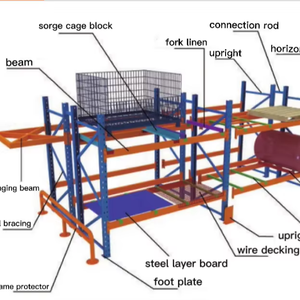
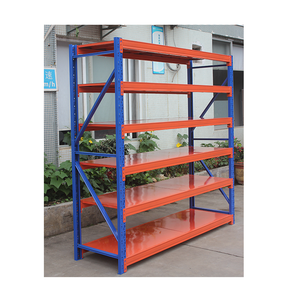
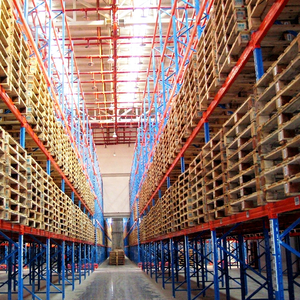
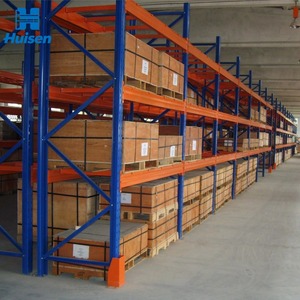
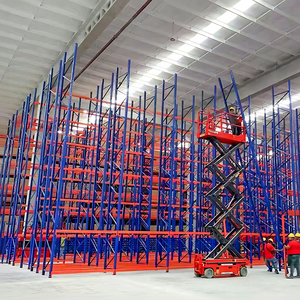
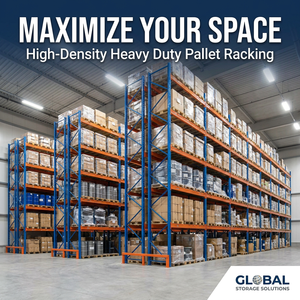
Selective pallet racking remains the most widely specified industrial storage system globally. Designed for maximum versatility, it offers 100% direct access to every single pallet position without requiring item relocation. Constructed from high-tensile cold-rolled steel, selective racks are optimized for distribution centers managing diverse stock-keeping units (SKUs).
- Structural Flexibility: Beam levels can be adjusted vertically at 50mm or 75mm increments, accommodating varying load heights seamlessly.
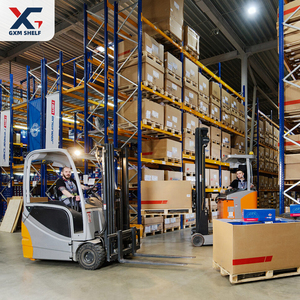
- Handling Compatibility: Fully compatible with standard counterbalance forklifts, reach trucks, and narrow-aisle (VNA) equipment.
- Load Capacity Spectrum: Engineered to support payloads from 1,000 kg up to over 4,500 kg per beam level under uniform distribution conditions (UDL).
2. High-Density Systems: Push-Back and Drive-In Solutions
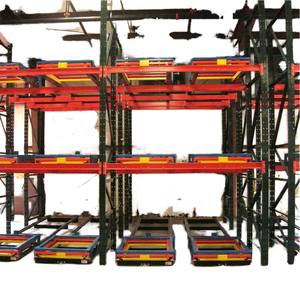
When warehouse footprints are constrained by escalating industrial real estate prices or high cold-storage energy expenses, high-density storage configurations yield unmatched operational ROI. Push-Back pallet rack systems utilize nested inclined carts riding on structural channels. When a pallet is loaded from the front, it pushes the preceding pallet back. Upon retrieval, gravity gently feeds the next pallet to the aisle face, operating on a Last-In, First-Out (LIFO) inventory logic.
Strategic Procurement Trends in Global Logistics (2026–2035)
Procurement directors and supply chain engineers face evolving economic pressures, requiring forward-looking asset investments. The trajectory of industrial storage hardware is defined by three macroeconomic and technological shifts:
1. Seismic Safety & Localized Building Code Compliance
Regulatory bodies across the Americas, Europe, and Asia-Pacific have tightened seismic design standards for industrial rack structures. Racks installed in seismic hazard zones—such as the Andean region under Colombia's NSR-10 framework, or California's RMI/ANSI MH16.1 mandates—must incorporate specialized engineering metrics:
- Custom Anchor Bolt Dynamics: Utilizing heavy-duty expansion or chemical anchors calculated against dynamic base plate shear forces.
- Upright Profile & Bracing Math: Heavy-gauge structural columns with targeted diagonal and horizontal bracing patterns to dissipate lateral seismic vibrations.
- Slab Interaction Studies: Analyzing concrete slab thickness and compressive strength to prevent punch-through failure during earthquake events.
2. Integration Readiness for AMR and Autonomous Pallet Shuttles
The transition toward automated warehousing no longer requires replacing existing physical storage racks entirely. Modern procurement strategies favor "Automation-Ready Racking." Uprights and runner rails are manufactured with ultra-tight tolerance thresholds, allowing easy retrofitting of 2D pallet shuttle carts, autonomous mobile robots (AMR), and bin-shuttle goods-to-person mechanisms.
3. Environmental Sustainability & ESG Sourcing
Industrial procurement now measures carbon intensity across structural materials. Our global manufacturing network aligns with rigorous Environmental, Social, and Governance (ESG) criteria. Facilities utilize renewable solar energy installations, closed-loop powder coating processes that yield zero volatile organic compounds (VOCs), and high-strength eco-grade steel that minimizes total raw material volume without compromising structural safety factors.
Technological Evolution & Material Selection Guidelines
Understanding structural steel specifications is essential for warehouse managers and structural engineers when evaluating wholesale rack proposals. The performance of a pallet rack system depends on steel grades, manufacturing processes, and protective coatings.
Cold-Rolled vs. Hot-Rolled Structural Steel
Selective and high-density racks primarily utilize high-tensile cold-rolled sheet steel. Cold-forming allows for complex profile geometry—such as multi-flanged teardrop or omega upright shapes—maximizing the strength-to-weight ratio. For extreme heavy-duty environments, such as port facilities, lumber yards, or heavy manufacturing plants subject to frequent forklift impact, structural hot-rolled structural channels offer unmatched toughness and resilience against physical deformation.
Surface Protection: Epoxy Powder Coating vs. Galvanization
Environmental conditions dictate component finish requirements:
- Electrostatic Powder Coating: Applied electrostatically and cured under heat, offering smooth impact-resistant color coding for indoor ambient operations.
- Hot-Dip Galvanization: Essential for humid, saline coastal environments (such as port terminals in Barranquilla or Miami) or sub-zero blast freezers. Galvanizing forms a metallurgical zinc bond that provides cathodic protection against steel oxidation and rust.
Frequently Asked Questions (Procurement & Engineering)
Expert guidance addressing common technical, compliance, and logistical inquiries from enterprise buyers.