OEM & Wholesale Product Catalogue
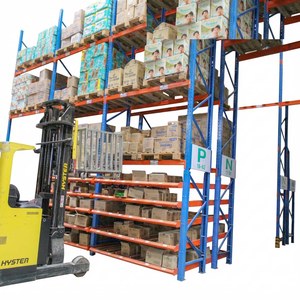
Heavy-Duty Industrial Storage & Racking Systems
Engineered for extreme structural capacity, ISO 9001 quality assurance, and compliance with European FEM 10.2.08 and US ANSI/RMI MH16.1 specifications.
Industry Whitepaper: Strategic Sourcing of Heavy-Duty Industrial Shelving (2026 Edition)
The modern industrial supply chain is experiencing a paradigm shift driven by e-commerce velocity, automated intra-logistics, and stringent land usage economics. Modern enterprise warehousing requires structural systems capable of maximizing Cubic Space Utilization Rates (CSUR) while satisfying rigorous seismic code compliances such as FEM 10.2.08 in Europe, ANSI/RMI MH16.1 in North America, and site-specific seismic standards like NSR-10. Evaluating candidates among the Top 10 Industrial Shelving Exporter & Wholesaler networks requires procurement teams to look beyond raw steel pricing per ton and thoroughly evaluate structural integrity, steel metallurgical certifications, corrosion dynamics, and automation compatibility.
Key Procurement Insight: Opting for cold-rolled high-tensile structural steel (e.g., Q355B / SS400 grade) with continuous automated laser welding improves frame yield strength by up to 28% over commercial-grade Q235 steel, reducing long-term floor deformation and total cost of ownership (TCO).
When auditing global manufacturers and export partners, procurement specialists must balance load capacity requirements with vertical adaptability. Industrial shelving covers a broad matrix of engineered sub-categories, ranging from heavy-duty boltless garage steel shelves engineered for manual picking to high-bay selective pallet racking, cantilever arms for long profiles, and multi-tier mezzanine floors integrated with 4-Way Radio Shuttle ASRS systems.
Supplier Vetting Framework
How to Benchmark the Top 10 Industrial Shelving Exporters
Four essential technical pillars evaluated by global logistics directors when selecting industrial shelving original equipment manufacturers (OEMs).
1. Steel Grade & Structural Integrity
Verification of cold-rolled high-tensile steel (EN 10149-2 standards) and continuous upright roll-forming to ensure uniform load distribution across beam connectors and baseplates.
2. Surface Treatment & C4 Coating
Electrochemical degreasing followed by thermo-set epoxy powder coating (60-80 microns thickness) or hot-dip galvanization to resist atmospheric corrosion in coastal or cold-room settings.
3. Seismic & Load Safety Factors
Computational Finite Element Analysis (FEA) dynamic simulations ensuring frame safety factors exceeding 1.55 against seismic acceleration, horizontal sway, and unexpected fork-truck impacts.
4. Global Export & Logistics Reach
Multi-plant manufacturing capacity, flat-pack export packaging designed for 40ft HQ container loading optimization, and seamless customs documentation for international trade.
Technical Specification Comparison Across Primary Industrial Racking Systems
Selecting the correct industrial storage architecture depends heavily on stock keeping unit (SKU) density, access frequency, payload profile, and material handling equipment (MHE) integration. The following matrix outlines standard engineering specifications provided by leading global wholesalers.
| Racking System Type | Payload Capacity (per level) | Max Vertical Reach | SKU Access Rate | Primary Industrial Application |
|---|---|---|---|---|
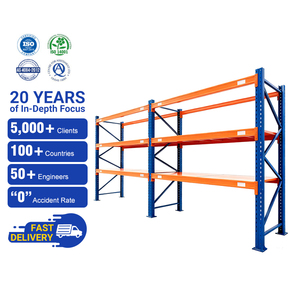
| Boltless Adjustable Shelving | 150 kg – 800 kg | Up to 4.5 meters | 100% Selective (Manual) | E-commerce fulfillment, spare parts, light industrial workbenches |
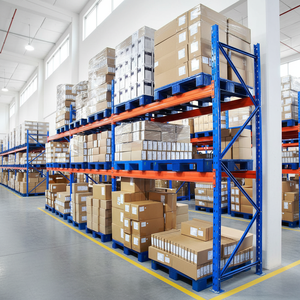
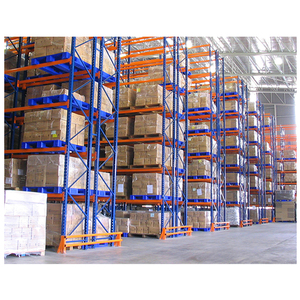
| Selective Pallet Racking | 1,000 kg – 4,500 kg | Up to 15 meters | 100% Direct Access | 3PL distribution centers, FMCG warehouses, general manufacturing |
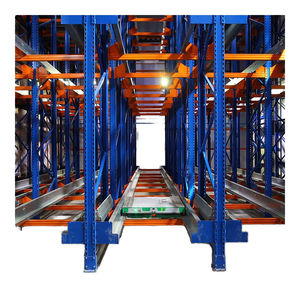
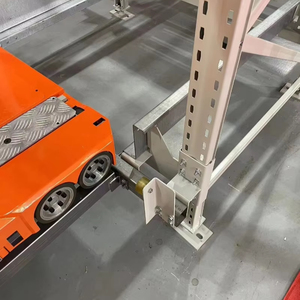
| Radio Shuttle ASRS Racking | 1,000 kg – 2,000 kg | Up to 24+ meters | Batch / LIFO or FIFO | Cold storage, food & beverage, high-density bulk inventory |
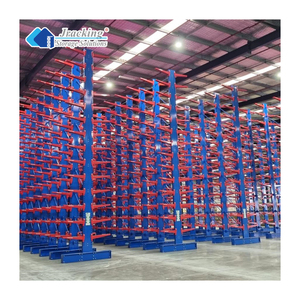
| Heavy-Duty Cantilever Racks | 500 kg – 6,000 kg / arm | Up to 10 meters | Direct Structural Access | Steel profiles, aluminum extrusions, timber, PVC pipe storage |
| Multi-Tier Mezzanine Platforms | 350 kg – 1,200 kg / sqm | 2 to 4 Deck Levels | Zoned High-Density Access | Automotive distribution, apparel picking, space expansion |
Future Sourcing Trends: Smart Logistics, Automation & Green Steel (ESG)
As warehouse operations transition toward full automation and near-zero emission mandates, industrial shelving manufacturers are actively re-engineering structural designs to meet three main future trends:
1. Autonomous Mobile Robot (AMR) Integration
Modern shelving units now incorporate precision guide rails, embedded IoT sensor channels, and baseplate anchor tolerances calibrated down to sub-millimeter scales for seamless interaction with AMRs, AGVs, and 2D/4D pallet shuttles.
2. Sustainable "Green Steel" & ESG Compliance
Leading European and global exporters are utilizing Electric Arc Furnace (EAF) recycled steel, solar-powered powder coating plants (e.g., 7,000+ roof solar panels), and volatile organic compound (VOC)-free thermoset coatings to support corporate Scope 3 decarbonization objectives.
3. Modular Boltless Rapid Reconfiguration
To adapt to rapidly changing e-commerce SKU dimensions, global buyers prioritize keyhole/butterfly-slot beam engagement systems that allow shelf height adjustments in 50mm or 75mm increments without specialized tools or structural dismantling.
Our Global Footprint & Enterprise Manufacturing Capabilities
With over four decades of dedicated structural engineering experience, our organization operates as a premier international manufacturer and global exporter of high-capacity warehouse racking systems. Combining state-of-the-art robotic welding cells, 8 worldwide manufacturing facilities (including an ultra-modern 240,000 sq ft production complex in Calhoun, Georgia, US), and a global team of over 2,000 logistics specialists, we deliver structural reliability at scale.
Whether outfitting localized retail fulfillment hubs or constructing mega-distribution centers across North America, Europe, Latin America (including Bogotá, Medellín, Cali, and Barranquilla), and Asia-Pacific, our project engineers execute comprehensive site calculations. Every component—from cold-rolled upright columns to diagonal bracing, load-bearing crossbeams, and expansion anchor bolts—is certified to perform safely under extreme thermal fluctuations, high humidity, and seismic loading events.
Structural Design per FEM 10.2.08 & ANSI RMI
ISO 9001:2015 & ISO 14001 Quality Certified
100% Traceable Cold-Rolled Carbon Steel
Complete OEM / ODM Custom Fabrication
Procurement Knowledge Base
Frequently Asked Questions by Industrial Storage Buyers
Expert engineering answers regarding structural safety, seismic calculations, import logistics, and custom OEM capabilities.
1. Why is structural steel grade selection crucial for heavy-duty warehouse shelving?
Steel grade directly dictates the ultimate yield strength and elastic deformation limit under maximum design loads. Using high-grade Q355B or EN 10149 cold-rolled steel ensures upright profiles withstand dynamic fork-truck placement, micro-vibrations, and eccentric load distribution without suffering permanent deflection or metal fatigue over decades of continuous multi-shift usage.
2. Do industrial racking installations require site-specific seismic engineering calculations?
Yes. Modern structural building codes (including North American RMI MH16.1, European EN 16681, and Latin American NSR-10) require pallet racking systems to be designed according to local ground acceleration parameters, soil dynamic shear moduli, concrete slab thicknesses, and total stored mass height. Generic standard catalog layouts should never be installed in seismic zones without professional engineering verification.
3. How do boltless shelving systems compare to bolted structural steel frames?
Boltless shelving utilizes interlocking teardrop, butterfly, or keyhole clip systems that dramatically speed up installation time by up to 60% while allowing tool-free level height adjustments. Bolted racking, conversely, is generally reserved for ultra-heavy structural applications or extreme vertical high-bay towers where fixed mechanical locking torques are mandated by specialized site conditions.
4. What surface finish options protect steel shelving in humid or cold-room operations?
For standard ambient distribution centers, an automated electrostatic epoxy-polyester powder coating (60–80 µm) provides excellent scratch and impact protection. For high-humidity coastal ports, agricultural processing centers, or sub-zero food cold storage (-30°C), continuous hot-dip galvanizing (HDG) per ISO 1461 is recommended to provide sacrificial cathodic protection against rust and chemical degradation.
5. How do high-density Radio Shuttle systems optimize cold storage operating expenses (OPEX)?
Refrigeration costs scale primarily with warehouse cubic air volume. 4-Way Radio Shuttle ASRS systems eliminate conventional aisle spaces required for forklift maneuvering, increasing pallet position density by 70% to 80% within the exact same building footprint. This drastically reduces the energy required per stored pallet position, delivering ROI within 18 to 24 months.
6. What key data must a buyer provide to receive a custom racking project engineering proposal?
Procurement teams should supply: (1) CAD building floor plan showing clear height to roof trusses and obstacle locations, (2) Concrete slab thickness and load-bearing rating (e.g., 30 kN/sqm), (3) Pallet specifications including dimensions, overhang, and maximum gross weight, (4) Operating temperature range, and (5) Material handling equipment specs (e.g., forklift reach height and aisle turning radius).
7. What international quality certifications should global exporters possess?
Reputable industrial rack exporters should maintain ISO 9001 (Quality Management System), ISO 14001 (Environmental Management System), ISO 45001 (Occupational Health and Safety), welding qualifications per ISO 3834-2, and structural steel compliance markings such as CE Marking under EN 1090-1.
Request a Custom Engineering Design & Wholesale Quote
Consult with our senior structural engineers today. We provide complimentary CAD layout drafting, structural load calculations, and global OEM export quotes tailored to your exact warehouse footprint.
Inquire Now