High-Density & Heavy-Duty Industrial Racking Systems
Engineered for maximum spatial volumetric efficiency, structural safety, and high-turnover warehouse operations.
Engineering Architecture of High-Density Push-Back Racks
A comprehensive analysis of LIFO kinematics, structural cold-rolled steel integrity, and compliance standards for global logistics hubs.
In modern industrial logistics, managing storage density versus SKU accessibility remains the quintessential engineering compromise. As land values escalate near major port corridors, logistics parks, and free trade zones, warehouse directors are increasingly turning to Push Back Racking Systems. Recognized globally as one of the most cost-effective dynamic high-density storage frameworks, push-back racking offers exceptional space utilization without requiring specialized forklift fleets or complex electrical automation infrastructure.
1. Kinematic Mechanics and Structural Anatomy
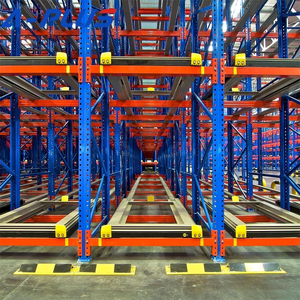
Push-back racking systems operate on a Last-In, First-Out (LIFO) inventory management logic utilizing nested, inclined cart assemblies or precision roller beds mounted inside structural steel channels. The core operational principle rests on gravity-assisted dynamic motion:
- Nested Cart Mechanisms: Standard configurations accommodate 2 to 6 pallets deep per lane. Pallets rest on individual nested steel carts that ride on inclined structural rails (typically angled at a precise 1.5° to 3° incline). When a forklift loads the first pallet, it sits on the top cart. Loading the second pallet pushes the first pallet backward, exposing the underlying second cart.
- Gravity Retrieval Dynamics: When unloading, the forklift gently backs away with the front pallet. Gravity automatically glides the remaining pallets forward to the picking face at a controlled speed, eliminating the need for forklifts to enter the rack structure itself (unlike traditional Drive-In systems).
- Structural Steel Selection: High-grade cold-formed structural steel (Q235B and Q355B yield strength specifications equivalent to ASTM A1011 grade 50) forms the upright frames and load beams, designed per EN 15512, FEM 10.2.02, and RMI (Rack Manufacturers Institute) standard calculations.
| Specification Parameter | Standard Engineering Threshold | Heavy-Duty Custom Configuration |
|---|---|---|
| Lane Depth Capacity | 2 to 4 Pallets Deep | 5 to 6 Pallets Deep (Custom Nested/Roller) |
| Maximum Load Per Pallet | 1,000 kg (2,200 lbs) | Up to 1,800 kg (4,000 lbs) per position |
| Incline Gradient Angle | 1.75° – 2.25° Slope Ratio | Calibrated per Dynamic Friction Coefficient |
| Frame Height Profiles | Up to 9,000 mm | Up to 12,500 mm (High-Bay Integrated) |
| Standard Finish Specification | Electrostatic Epoxy-Polyester Powder (60-80μ) | Hot-Dip Galvanized to ISO 1461 (>65μ) |
| Seismic Load Compliance | RMI & EN 15512 Baseline | NSR-10 / AS4084 High Seismic Acceleration Zone |
2. Critical Advantages Over Alternative High-Density Systems
When evaluating structural rack investments, enterprise procurement teams must compare push-back systems against conventional selective racking, drive-in racking, and automated pallet shuttles:
- 75% Increase in Floor Space Utilization vs. Selective Racking: By consolidating aisle space into dense storage blocks, push-back racking reclaims up to 40% to 75% of lost floor area, allowing facilities to increase total pallet positions dramatically.
- Superior Selectivity vs. Drive-In Racking: Drive-In systems suffer from severe honeycombing because an entire bay must be dedicated to a single SKU. In contrast, each level of a push-back rack can store a distinct SKU, radically enhancing picking selectivity across multi-tier distributions.
- Forklift Operating Safety: Forklifts never drive inside the rack structure. This minimizes rack damage risks, column collisions, and operator injuries—reducing long-term maintenance overhead by over 60% compared to Drive-In installations.
Why Sourcing from China's Premier Racking Manufacturers Matters
Combining world-class steel fabrication technology with rigorous international seismic engineering and direct B2B supply chain efficiency.
Advanced Robotic Steel Fabrication
Our production facilities utilize fully automated continuous roll-forming lines, laser profiling machines, and robotic welding cells to maintain strict manufacturing tolerances within ±0.5mm on upright profiles and beam connectors.
Seismic Design & NSR-10 / RMI Engineering
Every racking system is custom-engineered using finite element analysis (FEA) to withstand localized seismic zone conditions, floor slab shear forces, dynamic live loads, and spectral accelerations as required by international codes.
Corrosion-Resistant Surface Finishing
From humid coastal warehouses in Barranquilla or Cartagena to sub-zero cold storage units (-30°C), our zinc-rich pre-treatments, hot-dip galvanizing, and thermo-hardened powder coatings prevent rust oxidation for decades.
Integrated Safety Mechanisms
Equipped with heavy-duty mechanical end-stops, anti-bounce safety tabs, color-coded cart indicator systems, and forward-position safety stops to ensure zero cart derailment under rapid picking speeds.
Scalable Intralogistics Ecosystem
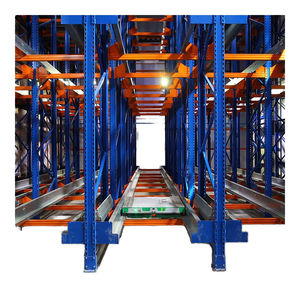
Seamlessly integrate push-back racking blocks with automated AMR (Autonomous Mobile Robots), pallet runners, and mezzanine floors, ensuring modular expansion as enterprise throughput scales.
Full Supply Chain Transparency & ESG
Committed to green logistics with roof-mounted photovoltaic solar powering plant production, green steel sourcing, and optimized flat-pack sea freight container load density to minimize scope 3 carbon footprints.
Future Procurement & Technological Trends in High-Density Racking
Key intralogistics innovations shaping wholesale purchasing decisions for supply chain leadership.
1. Hybrid Dynamic Racking & Pallet Shuttle Convergence
As logistics operations automate incrementally rather than overnight, enterprise buyers are increasingly specifying dynamic hybrid systems. Standard push-back rack corridors are engineered with structural footprints compatible with automated 2D Pallet Shuttle runners. This allows warehouse managers to deploy mechanical gravity cart systems today and effortlessly upgrade to semi-automated radio shuttles tomorrow as pallet throughput escalates.
2. Cold-Chain Energy Optimization
Energy costs represent up to 60% of cold storage operational budgets. Because freezing refrigerated volume is exponentially expensive, push-back racking provides an immense ROI in cold-storage applications. By reducing lost air space in freezer rooms, push-back systems maximize frozen thermal mass, lowering refrigeration compressor power requirements while maintaining fast LIFO access for fast-moving perishable commodities, pharmaceuticals, and fresh produce export hubs.
3. IoT Structural Health Monitoring & Smart Sensors
Future-proof push-back installations are moving beyond static steel structures. Modern high-bay push racks integrate IoT strain gauge micro-sensors and optical alignment monitoring along the incline channels. These sensors continuously track structural load deflections, detect accidental forklift impacts in real-time, and alert safety engineers before structural fatigue or alignment warping impacts cart kinetic safety.
Frequently Asked Questions (FAQ) for Enterprise Buyers
Technical guidance from senior storage engineers on specifying, ordering, and installing push-back racking.
Request a Custom Engineering Design & Wholesale Price Quote
Our senior storage engineers are ready to analyze your warehouse floor plan, structural seismic load demands, and throughput requirements to provide an optimized factory-direct proposal.
Contact Us