Industry Whitepaper & Strategic Sourcing Guide
The Engineering Evolution of Industrial Style Shelving & Warehouse Racking
In modern industrial logistics, supply chain resilience is directly linked to spatial efficiency and structural integrity. Selecting the right industrial style shelving supplier and wholesaler requires a deep understanding of load dynamics, material science, and operational ergonomics. As warehouse real estate costs continue to escalate globally, modern industrial storage systems have transitioned from basic static steel shelves into sophisticated, highly engineered modular frameworks capable of supporting thousands of kilograms per square meter while integrating smoothly with warehouse management software (WMS) and autonomous mobile robots (AMRs).
1. Technical Foundation of Industrial-Grade Shelving Engineering
Industrial style shelving and heavy-duty pallet racking are distinguished from commercial retail fixtures by their load-bearing capacity, cold-formed steel geometry, and fatigue resistance under cyclic forklift stress. Key structural engineering parameters include:
- Structural Steel Selection: Premium racking utilizes Q235B and high-strength Q355B structural steel profiles. Cold-rolled structural columns feature multiple multi-stage bends (up to 12-fold profile geometry) to enhance cross-sectional stiffness without unnecessarily increasing deadweight.
- Beam Connector Deflection Ratios: Standard engineering compliance dictates a maximum allowable beam deflection under full static load of L/200 (where L is the clear span beam length), preventing permanent deformation under continuous heavy loads.
- Surface Treatment Technology: Components undergo multi-stage chemical pretreatment, including degreasing, zinc phosphate conversion coating, and automated electrostatic epoxy-polyester powder spraying (60–80 µm coating thickness). For corrosive or humid environments—such as coastal ports or cold-storage units—hot-dip galvanizing (HDG) per ISO 1461 provides 50+ years of rust protection.
| Racking Architecture Type |
Typical Load Capacity |
Volume Density Ratio |
SKU Direct Accessibility |
Ideal Application Profile |
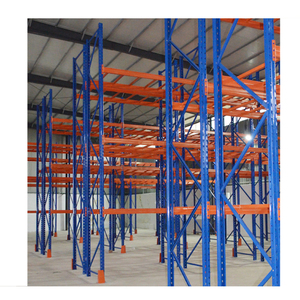
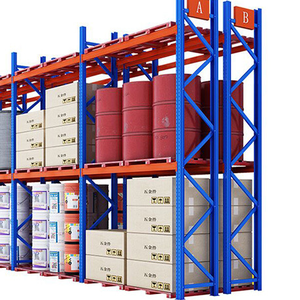
| Selective Pallet Racking |
1,000kg – 4,500kg / level |
40% – 50% |
100% Direct Access |
High-SKU distribution centers, 3PL fulfillment hubs. |
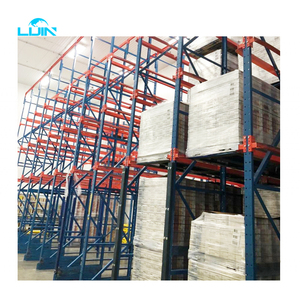
| Drive-In / Drive-Thru |
1,000kg – 2,000kg / pallet |
65% – 75% |
Low (LIFO / FIFO) |
Homogenous, high-volume seasonal goods, cold storage. |
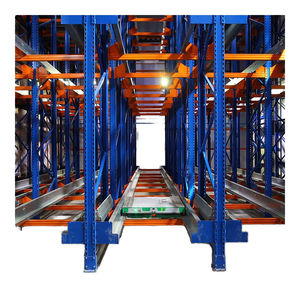
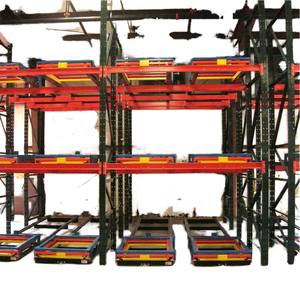
| Automated Pallet Shuttle |
500kg – 2,000kg / shuttle |
80% – 85% |
Controlled Automated Access |
High-throughput beverage, food manufacturing, sub-zero cold rooms. |
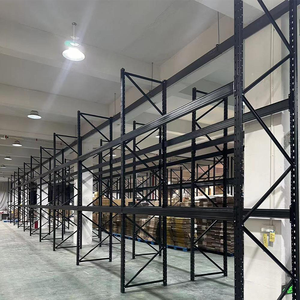
| VNA (Very Narrow Aisle) |
1,000kg – 3,500kg / level |
60% – 70% |
100% Direct Access |
Limited footprint warehouses with high ceiling clearance (>12m). |
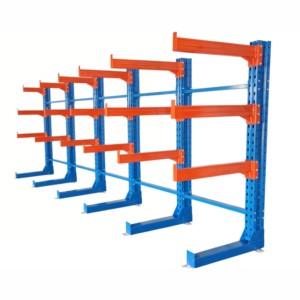
| Heavy-Duty Cantilever |
500kg – 3,000kg / arm |
Custom Variable |
Direct Arm Access |
Long extrusions, timber, steel tubes, sheet materials. |
2. Product Development Trends: The Shift Towards Hybrid & Automated Storage
The global warehouse automation market is expanding rapidly, driving a fundamental convergence between traditional heavy-duty steel shelving and robotic picking ecosystems. Industrial shelving designs are evolving to accommodate new automated workflows:
- Pallet Runner & Radio Shuttle Integration: Semi-automated deep-lane shuttle systems replace forklift travel aisles with self-propelled battery-powered shuttle cars. This increases total storage density by over 70% compared to traditional selective racking while drastically cutting forklift engine fuel/electricity usage and reducing structural column impact risks.
- AMR-Compatible Mezzanine Platforms: Structural steel mezzanines are increasingly retrofitted with high-flatness steel deck plates designed to facilitate Autonomous Mobile Robot (AMR) navigation for goods-to-person picking operations.
- Smart Structural Health Monitoring: Next-generation high-bay racking systems integrate wireless piezoelectric strain sensors and vibration monitors. These sensors automatically alert facility managers to seismic events, thermal expansion stress, or vehicle collisions that exceed structural safety margins.
3. Future Procurement Trends: Strategic Sourcing from China Suppliers
Global procurement directors and supply chain managers are adopting total cost of ownership (TCO) models when evaluating Chinese industrial shelving manufacturers. Sourcing decisions are no longer guided solely by initial FOB price per metric ton, but by long-term structural reliability, modular adaptability, and compliance assurance:
A. Material Traceability and Eco-Certifications: Leading buyers mandate environmental product declarations (EPDs) and zero-VOC powder coating compliance. Facilities using solar power for steel fabrication and waterborne cleaning pre-treatments enable international enterprise clients to meet strict ESG and carbon accounting targets.
B. Modular Flat-Pack Engineering: International freight optimization requires components engineered specifically for container cubing efficiency. Advanced beam-to-column connectors, teardrop punch patterns, and boltless structural bracings minimize shipping air space while accelerating on-site installation speeds by up to 40%.
C. Standardized Interoperability: Modern B2B logistics projects favor structural systems that seamlessly accept universal accessories—such as wire mesh decks, drop-in pallet support bars, row spacers, and heavy-duty column protectors—ensuring future layout modifications do not lock facility owners into proprietary hardware ecosystems.