Featured Industrial Racking & Storage Systems
Engineered to rigorous EN 15512 and CE compliance standards for heavy-duty industrial application.
CE Certified Racking Engineering: Compliance, Metallurgy, and Structural Rigor
In modern high-density warehousing and automated logistics, specifying warehouse racking solutions requires far more than comparing surface-level steel gauge thicknesses or unit costs. For global logistics directors, safety compliance officers, and warehouse facility engineers, ensuring structural integrity under full static and dynamic load profiles is a mandatory operational requirement. CE marking on industrial racking systems serves as a formal declaration that the structural assembly meets stringent European Union safety, health, and environmental protection requirements—specifically governed by the Construction Products Regulation (CPR 305/2011) and EN 1090 structural steel execution standards.
Deploying non-certified industrial shelving or pallet racking creates severe structural liability risks. Uncertified racks often exhibit micro-structural inconsistencies, inadequate flexural rigidity, unverified weld integrity, and unpredictable buckling coefficients under peak asymmetrical load scenarios. Modern CE certified racking factories adhere to strict design principles outlined in EN 15512 (Steel static storage systems - Adjustable pallet racking systems - Principles for structural design) and EN 15620 (Tolerances, deformations, and clearances), ensuring that every upright frame, beam connector, and floor anchor operates well within defined safety margins.
Structural Engineering Principle: Limit State Design (EN 15512)
Unlike traditional Allowable Stress Design (ASD), modern CE certified racking engineered under EN 15512 utilizes Advanced Limit State Design methodology. This evaluates both Ultimate Limit States (ULS)—preventing structural collapse, frame side-sway, or shear failure of beam connectors—and Serviceability Limit States (SLS), ensuring beam deflection does not exceed L/200 under maximal working load capacities.
Material traceability forms the backbone of CE structural integrity. Leading manufacturing plants utilize premium cold-formed structural steel grades such as Q235B, Q355B, and S350GD structural steel. These grades are subjected to continuous tensile testing, Charpy impact tests, and chemical composition verification to ensure strict yield strength limits (ranging from 235 MPa to over 355 MPa). Cold-roll forming profiles are engineered with dynamic rib geometry and stiffness flanges to maximize section modulus while optimizing material weight efficiency.
Factory Manufacturing Capabilities & Quality Engineering Matrix
Why premier logistics operators and global supply chain leaders partner with our certified manufacturing hubs.
Automated Precision Roll-Forming
Equipped with state-of-the-art multi-stage continuous roll-forming lines with inline CNC punch punching. Upright perforation tolerances are maintained within ±0.2mm, enabling seamless pitch adjustment and stress-free load distribution during beam engagement.
Robotic Fillet Welding & NDT
Beam-to-claw connector brackets are welded using fully automated robotic MIG/MAG cells. Continuous seam integrity is regularly monitored via ultrasonic non-destructive testing (NDT) to prevent fatigue cracking under cyclic forklift loading.
16-Stage Surface Pre-treatment
Components undergo continuous degreasing, zinc-phosphate conversion coating, and electrostatic epoxy-polyester powder baking (60–80 microns depth). Formulated to exceed 500 hours of salt spray corrosion tests for high-humidity and cold-storage environments.
Structural Engineering & Manufacturing Specification Matrix
| Racking System Type | Standard Load Rating | Steel Grade Options | Execution Standards | Surface Finish Options | Seismic Mitigation |
|---|---|---|---|---|---|
| Selective Pallet Racking | Up to 4,500 kg / level | Q235B, Q355B, S350GD | EN 15512, EN 15620, FEM 10.2.02 | Epoxy Powder / Pre-Galvanized | Custom Baseplates & Anchors |
| Heavy Duty Cantilever | 500 - 2,000 kg / arm | Hot-Rolled Structural Q355B | EN 1090-2 EXC2 / EXC3 | Hot-Dip Galvanized / Powder Coated | Moment-Resisting Column Bases |
| Long Span Metal Shelving | 300 - 1,000 kg / shelf | Cold-Rolled Steel Q235B | EN 16681, FEM 10.2.06 | Thermoset Powder Coating | Floor Tie Brackets & Shim Plates |
| Multi-Tier Mezzanine Floors | 300 - 1,500 kg / m² | Universal Beam Structural Steel | EN 1993 (Eurocode 3), CE EN 1090 | Anti-Slip Decking / Galvanized Mesh | Braced Frame Cross-Tie Arrays |
| 2D Radio Pallet Shuttle | Up to 1,500 kg / pallet | High-Precision Profile S350GD | 2006/42/EC Machinery Directive | Powder Coating / Stainless Rails | Rail Locking & Anti-Tipping Tabs |
Industrial Racking Solutions Portfolio & Structural Application
1. Selective Pallet Racking Systems (3000kg+ Heavy Duty Class)
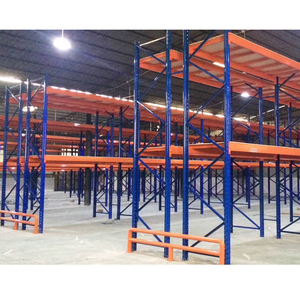
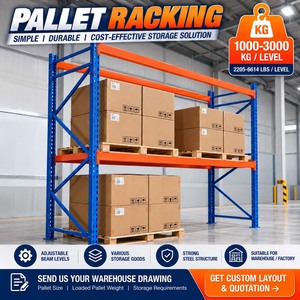
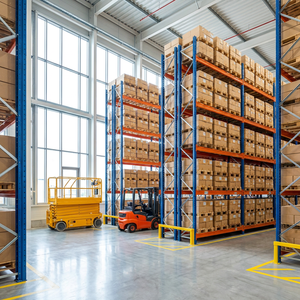
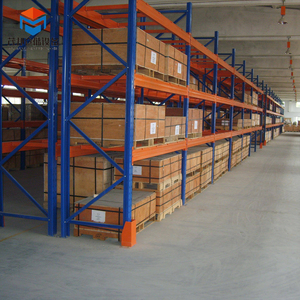
Selective pallet racking remains the most widely deployed structural storage geometry across high-throughput distribution centers. Designed for 100% immediate pallet accessibility, CE certified selective racking incorporates upright frames manufactured from cold-formed C-sections or teardrop profiles with stiffening return flanges. Horizontal and diagonal bracing members are attached via high-tensile grade 8.8 structural bolts to form rigid planar trusses capable of handling severe lateral loads.
Beams utilize multi-hook connector claws that lock tightly into upright slots under gravitational load. Integrated automatic safety locks prevent accidental beam displacement caused by upward forklift mast impacts. Beam profiles range from box sections to step-beams engineered with specific section moduli to eliminate rotational torsional buckling.
2. Heavy Duty Cantilever Racking Systems
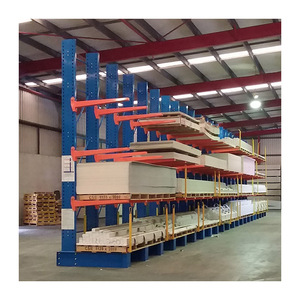
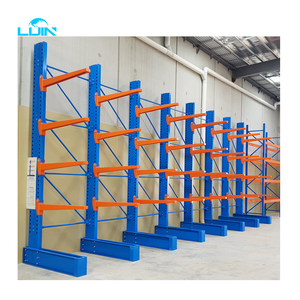
For non-standard, linear, or continuous long-item loads—such as steel pipes, timber bundles, plastic extrusions, and aluminum profiles—cantilever racking provides an unobstructed horizontal storage plane. Columns are constructed from heavy hot-rolled structural steel profiles (e.g., IPE or H-beams) welded securely to substantial base plates.
Adjustable arms feature tapered profile design: the arm cross-section narrows toward the outer tip, matching the bending moment diagram and preventing unnecessary dead weight while maximizing carrying capacity. Arms connect to uprights via high-strength steel pins, allowing vertical adjustment in 75mm or 100mm increments while pivoting harmlessly upward if struck by handling equipment.
3. Longspan Shelving & Assembly Modular Rack Systems
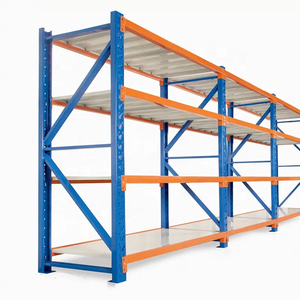
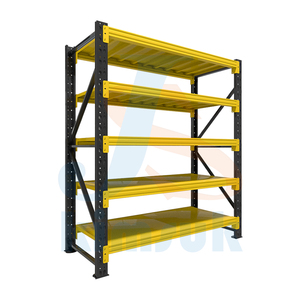
Targeted at hand-loaded, medium-to-heavy stock storage, longspan shelving bridges the gap between light industrial shelving and heavy pallet racking. Utilizing stepped beams with drop-in steel, wire mesh, or particle board decks, longspan racks accommodate localized point loads without sag. Frame configurations support integration into multi-tier walkways, doubling or tripling effective warehouse space footprint without expanding physical facility walls.
4. High-Density Automated Radio Pallet Shuttle Systems
Addressing the growing demand for cubic space utilization, radio shuttle racking leverages semi-automated self-powered shuttles running within high-density storage channels. Engineered to the EU Machinery Directive 2006/42/EC, shuttle channels feature high-precision roll-formed running rails that guide the shuttle, support deep pallet loads, and maintain structural frame alignment. Radio pallet shuttle systems drastically reduce forklift travel distance, minimize aisle space requirements, and increase overall pallet storage density by up to 80% compared to conventional layout configurations.
Future Procurement & Manufacturing Trends in Racking Systems (2025–2030)
The global warehouse rack supply chain is transitioning through an unprecedented phase of technological integration and environmental sustainability mandates. Industrial buyers and supply chain executives must account for five structural procurement trends over the next decade:
1. Automated AMR & AGV Compatibility
Traditional racking design assumes human forklift operator margins. Next-generation certified racking demands extreme floor levelness tolerances (EN 15620 Class 300) and laser-aligned guide paths to accommodate Autonomous Mobile Robots (AMRs) and Automated Guided Vehicles (AGVs).
2. Green Steel & Scope 3 Decarbonization
Under EU Carbon Border Adjustment Mechanisms (CBAM) and corporate ESG reporting rules, tier-1 suppliers are adopting low-carbon electric arc furnace (EAF) steel, recycled scrap content, and zero-VOC powder coat lines to reduce carbon intensity per pallet location.
3. Digital Twin & IoT Strain Monitoring
Smart racking installations are adopting wireless IoT strain sensors embedded directly into critical upright bases and beam connectors. These sensors deliver real-time load telemetry, instantly alerting warehouse managers to structural overload or forklift impact damage.
Furthermore, cold-chain expansion in pharmaceutical and frozen food logistics is accelerating demand for high-grade low-temperature cold-formed steels. Standard carbon steel experiences ductile-to-brittle transition when exposed to sub-zero temperatures (-25°C to -30°C). Future-proof procurement requires cold-storage rated structural steel grades with verified Charpy V-notch impact toughness values down to -30°C.
Industrial Procurement FAQ: Technical Deep Dive
Critical regulatory, engineering, and factory selection answers for procurement specialists.
Request Complete Technical Specifications & Factory Price List
Partner with a trusted, CE certified global manufacturer. Speak with our structural engineering team today to review your CAD layout, seismic requirements, and custom rack specifications.
Get Catalog