CE Certified / Heavy Duty
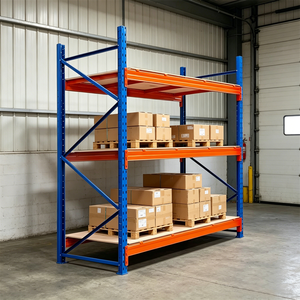
Powder Coated Heavy Duty Rack Industrial Warehouse Storage Pallet Racking Adjustable Industrial Shelves
Cap: Up to 4,500 kg/beam
Pitch: 50mm/75mm
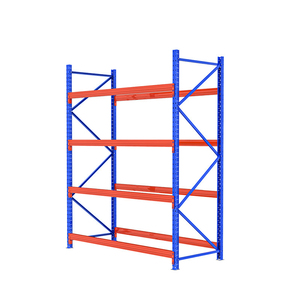
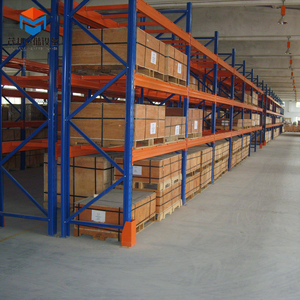
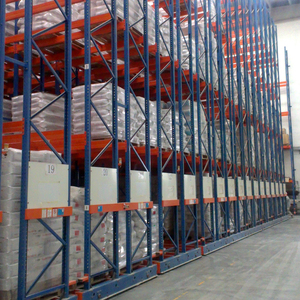
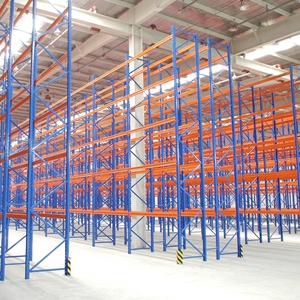
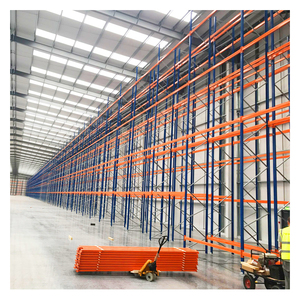
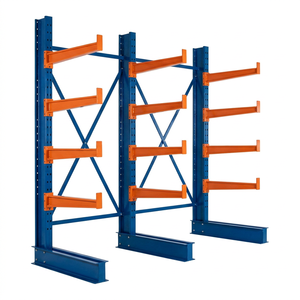
In modern high-density logistics, pallet racking systems are no longer treated as simple static furniture; they are highly calculated structural steel mechanisms subject to complex axial loads, dynamic fork-truck impacts, and seismic excitations. Procuring CE Certified Warehouse Pallet Racks guarantees that your storage matrix strictly complies with European Union Construction Products Regulation (CPR 305/2011), EN 15512 structural design codes, and rigorous factory production controls under EN 1090-1.
When enterprise procurement officers specify industrial storage systems, evaluating structural integrity goes far beyond checking price-per-pallet position. Non-certified racking frames lack verified structural safety factors, leading to progressive buckling under live load vibrations or micro-seismic shifts.
Our manufacturing ecosystem utilizes high-tensile structural steel (S355JR / S420 cold-rolled coils) combined with precision automated roll-forming lines. Every upright frame design undergoes rigorous Finite Element Analysis (FEA) and physical shear-connection testing to ensure guaranteed yield strength and ultimate limit state performance.
E-E-A-T Guarantee: Fully documented mill certificate compliance (EN 10204 3.1) accompanying every wholesale batch shipment worldwide.
| Compliance Parameter | Standard Specs | Enterprise Value |
|---|---|---|
| Design Standard | EN 15512 / FEM 10.2.02 | Verified beam deflection limits (≤ L/200) |
| Factory Control | EN 1090-1 EXC2 / EXC3 | Certified robotic welding & non-destructive testing |
| Steel Yield Grade | S355 / S420 Cold-Formed | High load-to-weight ratio; superior buckling resistance |
| Seismic Standard | EN 16681 / NSR-10 / RMI | Site-specific ground acceleration response design |
| Corrosion Class | ISO 12944 (C2 to C5-I) | Thermosetting epoxy coat or Hot-Dip Galvanized |
As enterprise supply chains adapt to geopolitical shifts, nearshoring initiatives, and escalating urban real estate costs, industrial storage procurement is undergoing a paradigm shift. Procurement directors must anticipate structural innovations to prevent asset obsolescence.
Rising land costs in prime logistics hubs (such as industrial trade zones and port-adjacent corridors) are driving building clear heights from 10 meters up to 30-40 meters. Procurement is shifting toward Clad-Rack Buildings (Rack-Supported Structures) where pallet racking serves as the main structural shell of the warehouse.
Safety compliance is transitioning from annual manual rack inspections to continuous real-time dynamic monitoring. Next-generation CE-certified racking incorporates strain gauges and acoustic emission sensors within critical beam-column nodes.
Global logistics operators are enforcing strict Scope 3 carbon emission caps. Wholesalers and factory partners who manufacture racking using green hydrogen-reduced steel and renewable factory microgrids will hold a decisive competitive advantage in tender evaluations.
Standard selective pallet racking is undergoing technological convergence. The future of material handling lies in structural rack designs specifically engineered to interface with Autonomous Mobile Robots (AMRs) and automated shuttle carriers.
Conventional drive-in racks are rapidly being replaced by Semi-Automated and Fully Automated Pallet Shuttle Systems. By deploying self-powered shuttle vehicles inside specially profiled racking channels, warehouses achieve depth capacity up to 40 pallets deep while completely eliminating forklift entry risks inside storage channels.
Key technological developments include ultra-thin profile shuttle rails engineered from high-strength cold-formed galvanized profiles, integrated wireless optical positioning, and multi-directional 2D matrix level-changing lifts.
Logistics corridors located along high-seismic activity regions—such as the Andean volcanic belt (Colombia, Chile, Peru) and the Pacific Rim—require dynamic seismic energy dissipation capabilities. Modern CE racking designs integrate ductility-engineered baseplates, micro-alloyed bracing systems, and high-energy absorption anchors calculated per site-specific spectral acceleration data.
Rather than simply increasing steel thickness, advanced dynamic simulation ensures that racking systems flex under seismic load without catastrophic node disengagement or shear collapse.
Building on a strong engineering heritage since 1977 and operating as part of an international manufacturing power house (including our new 240,000 sq ft state-of-the-art production plant in Calhoun, Georgia, USA), we provide enterprise-grade racking solutions tailored to rigorous regional codes.
Our 8 worldwide production facilities utilize multi-stage automated roll-forming lines, laser profiling, and continuous robotic welding cells. Every batch undergoes strict spectral material analysis, coat thickness testing (ISO 2178), and load-to-destruction sample testing.
By sourcing directly from our factory floor, procurement partners eliminate middleman markups while gaining full transparency over rolling schedules. Our expanded production footprint across Europe and North America ensures short lead times and resilient bulk container shipping.
We actively drive sustainable industrial manufacturing. Our primary factory rooftop features over 7,000 solar photovoltaic panels generating clean operational power, while our global logistics strategy prioritizes inland waterway and electrified fleet transport target by 2028.
Detailed answers compiled by our senior structural engineers to address technical, compliance, and commercial questions during global warehouse racking tenders.
CE Certification for industrial pallet racking is governed under the European Construction Products Regulation (CPR 305/2011) and EN 1090-1 / EN 15512 codes. To carry a valid CE mark, the structural manufacturer must demonstrate:
1. Factory Production Control (FPC): Audited quality management protocols ensuring traceability of steel coils from mill to finished profile.
2. Structural Load Calculation: Verification of beam deflection (≤ L/200), upright column buckling under axial load, and shear connector safety margins using EN 15512 calculation models.
3. Welding Certification: Automated robotic welding complying with EN ISO 3834 and certified non-destructive testing (NDT) routines.
While both EN 15512 (European) and ANSI MH16.1 (RMI - Rack Manufacturers Institute, USA) ensure safe racking performance, they differ in safety factors and testing methodologies. EN 15512 relies heavily on limit state design using partial safety factors applied separately to dead loads, live loads, and material yield strength.
Additionally, EN 15512 mandates full-scale physical testing of stub columns, beam-to-upright connectors, and floor baseplate assemblies to empirically determine stiffness matrices before numerical simulation. Our engineering team provides dual-compliant structural calculations for international projects spanning EMEA and the Americas.
The optimal finish depends entirely on the operational warehouse environment:
• Thermosetting Epoxy-Polyester Powder Coating: Ideal for indoor dry ambient distribution centers, retail fulfillment hubs, and automated warehouses. Provides high impact resistance, smooth aesthetically clean surfaces, and wide color customization options.
• Hot-Dip Galvanizing (EN ISO 1461): Essential for outdoor storage, highly humid coastal logistics facilities (e.g., Caribbean or Atlantic port cities), chemical storage, and deep-freeze cold storage operations where condensed moisture causes rapid oxidation on standard steel coatings.
Yes. Much of Colombia, along with neighboring Andean countries, sits within intermediate-to-high seismic hazard zones under the NSR-10 (Norma Sismo Resistente Colombiana) standard. Generic catalog racking MUST NOT be installed without site-specific seismic engineering.
Frame bracing geometry, baseplate thickness, floor slab anchor depth, and beam connector lock systems must be engineered against peak ground acceleration (Aa/Av coefficients), local soil profile types, and actual pallet load centers to prevent structural resonance collapse during dynamic earth tremors.
To deliver an accurate structural study, FEA simulation, and wholesale commercial quote, please prepare the following parameters:
1. Architectural CAD layout drawing showing building clear height, column grid matrix, and door/aisle constraints.
2. Concrete floor slab specifications (compression strength, thickness, reinforcement mesh, and flatness classification per DIN 18202 or ASTM E1155).
3. Pallet specifications: dimensions (W x D x H), maximum payload weight, bottom runner orientation, and SKU distribution.
4. Material handling equipment details (forklift type, max lift height, right-angle stacking aisle requirement).
Standard manufacturing lead time for custom rolled structural components is typically 4 to 6 weeks from technical drawing sign-off. Backed by our multi-facility manufacturing network (including plants in Europe and the USA), we can split production volume across facilities to meet urgent greenfield project deadlines. Bulk orders are securely containerized and shipped directly to major ocean ports globally.