0%

A warehouse can hold thousands of pallets, yet poor access can turn daily picking into wasted travel. A Pallet Storage Racking System uses steel frames and beams to store palletized goods above the floor. It creates organized storage levels and keeps products accessible to forklifts. Common configurations include selective, drive-in, and push-back racking. Each serves different needs for access, product rotation, and storage density.

The design depends on more than available floor space. Pallet dimensions, load weights, forklift turning space, and building height all matter. So do clear labels and regular checks for damaged frames or beams. MHI’s 2024 Annual Industry Report found that 88% of surveyed supply chain professionals planned to increase technology investment. That figure reflects wider pressure to improve operations; it does not prove that every warehouse needs more racking. A rack is not a strategy. Poorly chosen layouts can restrict access or create avoidable risks. This guide explains how pallet racking works, compares common system types, and outlines the key factors to assess before installation. Real warehouses are messy, and a neat drawing may not capture every workflow. That is worth remembering.
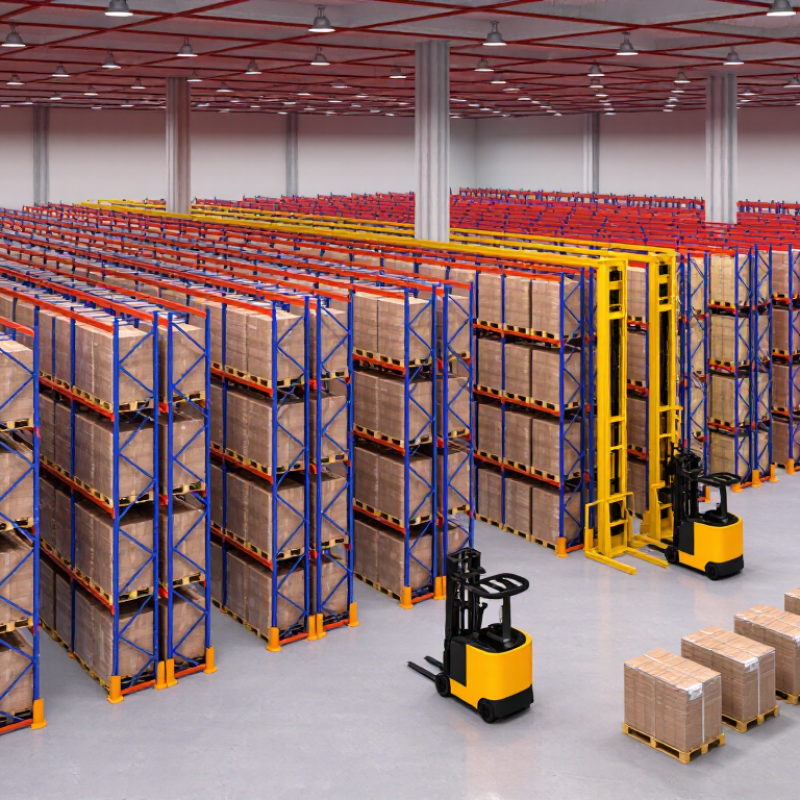
What Is a Pallet Storage Racking System?

Pallet Rack Basics: How 48 × 40-Inch GMA Pallets Fit the System

A pallet storage racking system holds unit loads on horizontal beams supported by upright frames. Its fit depends on pallet dimensions, load weight, and safe clearances. ANSI MH1-2016 covers pallet dimensions and construction, including the familiar 48 × 40-inch footprint. The National Wooden Pallet and Container Association estimates that about 1.8 billion pallets are in use in the United States. That scale makes consistent sizing useful, but it does not make every rack interchangeable.

In a common selective-rack layout, the pallet’s 48-inch side faces the aisle, resting across the beams; its 40-inch side extends into the rack. A roughly 42-inch-deep frame can leave about one inch of clearance at the front and back. Two nominal 48-inch-wide pallets may fit across a 96-inch beam span, but real pallets vary. Check actual load dimensions, including any cartons that overhang. Small gaps matter. Rack capacity also depends on beam span, frame height, and load distribution, as reflected in Rack Manufacturers Institute guidance. Verify the rack’s rated capacity and the pallet’s condition before loading. I’ve seen “standard size” treated as a guarantee; it isn’t.

Core Components: Upright Frames, Beams, Bracing, and Load Plates

A pallet storage racking system transfers stored loads through several connected parts. Upright frames are the vertical columns, usually perforated for beam adjustment. Beams lock into those frames and carry pallet loads; their connectors must be fully engaged. Bracing ties the uprights together, helping the frame resist sway. Small details matter. A bent brace or damaged connector can change how the structure behaves. Real warehouses are rarely perfectly square, so installation checks deserve more attention than they sometimes get.

Load plates identify permitted loads for a particular rack configuration. They are not estimates, and a plate from another bay may not apply. Check that the displayed rating matches the beam levels, frame spacing, and load arrangement in use. The Rack Manufacturers Institute’s ANSI MH16.1 specification covers the design, testing, and use of industrial steel storage racks. MHI and Deloitte’s 2024 Annual Industry Report surveyed more than 1,000 supply-chain professionals; 55% expected to increase investment in supply-chain innovation. Modernization may prompt rack changes, but a technology upgrade does not itself verify capacity. After alterations or impact damage, get the system assessed by a qualified rack professional and update capacity information where needed. A quick visual check helps, but it cannot replace a proper assessment.

Rack Configurations: Selective, Drive-In, Push-Back, and Pallet-Flow

A pallet storage racking system holds goods on pallets in a warehouse, but its configuration shapes how workers reach each load. Selective racking gives every pallet a direct aisle-facing position. It suits mixed inventory and frequent picking. The trade-off is clear: access is easy, but aisles use valuable floor space. Measure turning room for forklifts, not just rack dimensions.

Drive-in racks let forklifts enter storage lanes, placing pallets on rails from the front inward. This can increase storage density for many pallets of the same product. It works best when stock rotates in a planned sequence. Use care. Forklift contact can damage rails, so clear operating rules and regular inspections matter.

Push-back systems store pallets on nested carts. A new pallet pushes earlier ones deeper, while unloading brings the next pallet forward. Pallet-flow racks use a slight slope and rollers to move loads from the loading face to the picking face. Both configurations can reduce aisle demands, though their mechanics need attention. Check pallet condition, load consistency, and braking or flow controls before choosing. A chipped pallet may stall. That detail is easy to overlook. Compare daily picking patterns with storage capacity; the densest layout is not always the easiest one to run. An imperfect inventory count can also undermine an otherwise efficient design.

What Is a Pallet Storage Racking System? - Rack Configurations: Selective, Drive-In, Push-Back, and Pallet-Flow

Rack Configuration How It Works Pallet Access Storage Density Common Applications Key Considerations
Selective Pallets are stored on beams in individual rack bays, with aisles providing forklift access to each storage position. Direct access to every pallet; typically supports first-in, first-out (FIFO) or last-in, first-out (LIFO) picking. Low to moderate, because aisles are needed between rack rows. Warehouses with many product types, frequent picking, or varied inventory turnover. Offers high selectivity and straightforward access, but generally uses more floor space for aisles than high-density systems.
Drive-In Forklifts enter storage lanes and place pallets on support rails. Multiple pallets are stored deep within each lane. Limited access; pallets in a lane are generally handled in last-in, first-out (LIFO) order. High, since fewer aisles are needed and pallets are stored several positions deep. Large quantities of similar products with relatively low SKU variety and less frequent access to individual pallets. Requires careful forklift operation inside lanes. Pallet consistency, load stability, lane depth, and operating procedures are important.
Push-Back A new pallet pushes previously stored pallets backward on nested carts or tracks. When a pallet is removed, the next pallet moves forward. Typically LIFO within each lane; each lane is usually assigned to one SKU or product group. Moderate to high, with multiple pallet positions stored deep while maintaining access from the aisle face. Operations needing more storage density than selective rack and frequent access from a single aisle. Pallet weight, dimensions, and condition should be consistent enough for smooth movement. The system is generally LIFO, not FIFO.
Pallet-Flow Pallets are loaded at the higher end of inclined roller or wheel lanes and move by gravity toward the picking face. Usually FIFO: pallets are loaded at one end and retrieved from the opposite end. High, with multiple pallet positions per lane and fewer operating aisles than selective rack. High-throughput inventory, date-sensitive goods, and operations that benefit from stock rotation. Needs compatible, stable pallets and properly designed flow lanes. Braking, separation, and maintenance requirements should be considered.

Note: Actual storage capacity, aisle requirements, and suitability depend on the building layout, pallet and load specifications, handling equipment, operating practices, and applicable design and safety requirements.

Load Capacity: How ANSI/RMI MH16.1 Guides Rack Design

A pallet storage rack’s capacity is not a single number that applies to every installation. ANSI/RMI MH16.1-2021, the Specification for the Design, Testing and Utilization of Industrial Steel Storage Racks, provides engineering requirements for evaluating rack components and configurations. Designers consider beam spans, upright frames, bracing, connections, floor anchorage, and site conditions. Seismic forces can also affect the design. Small details matter.

A beam rating alone does not establish safe capacity for a complete rack bay. The intended load, pallet footprint, beam level, and load distribution all count. A tilted pallet or unevenly placed cartons can change how forces reach the beams. The U.S. Bureau of Labor Statistics’ 2022 Survey of Occupational Injuries and Illnesses reported 4.8 total recordable cases per 100 full-time workers in warehousing and storage. That figure is not a rack-failure rate, but it underscores the value of careful warehouse safety practices. Verify the installed configuration against its engineered drawings and posted load limits. If a layout changes, reassess it. A tidy load chart can still mislead when the rack has been altered.

Safe Use: How OSHA 1910.176(b) Applies to Stored Materials

What Is a Pallet Storage Racking System?
Safe Use: How OSHA 1910.176(b) Applies to Stored Materials

A pallet storage racking system holds palletized goods on supported beams, creating vertical storage bays. Each pallet, beam, and upright must suit the load and the way materials are placed. A stable-looking rack is not automatically safe. Check the rack’s rated capacity and keep loads within it.

OSHA 1910.176(b) requires stored materials stacked in tiers to be stable and secure against sliding or collapse. They must be stacked, blocked, interlocked, and limited in height as needed. In a rack, that means placing pallets squarely on their supports, keeping loads centered, and preventing cartons or items from overhanging or shifting. Damaged pallets and uneven loads can undermine stability. In practice, the neatest-looking bay is not always the safest one; load condition matters, too.

Tips: Look for leaning pallets, crushed cartons, and visibly damaged rack parts during routine checks. Keep heavy loads low when the rack design allows. Train workers to report changes rather than adjust damaged components themselves. Small details are easy to miss. A quick glance may not reveal a hidden broken board.

FAQS

What is selective pallet racking best suited for?

It suits mixed inventory and frequent picking. Each pallet has a direct aisle-facing position. Easy access, but aisles take floor space.

When does drive-in racking make sense?

It can store many pallets of the same product in compact lanes. Forklifts enter the lanes to place pallets on rails. Plan stock rotation carefully.

How do push-back and pallet-flow racks work?

Push-back racks use nested carts; each new pallet moves earlier pallets deeper. Pallet-flow racks use rollers and a slight slope. Check controls and pallet condition.

What should be checked before choosing a dense rack layout?

Compare storage capacity with daily picking patterns. Measure forklift turning room, too. The densest layout may be harder to operate.

Does a beam rating show the capacity of an entire rack bay?

No. Capacity depends on the complete installation, including beam spans, frames, bracing, connections, anchorage, and site conditions.

How can pallet placement affect rack loads?

A tilted pallet or uneven cartons can change how forces reach the beams. Small placement errors matter.

What should workers do if a rack layout changes?

Reassess the altered configuration against its engineered drawings and posted load limits. A neat load chart can still mislead.

Why do pallet and rack inspections matter?

Forklift contact can damage drive-in rails. A chipped pallet may stall in a flow rack. Easy to overlook.

Conclusion

A Pallet Storage Racking System is designed to store palletized goods in an organized, accessible, and space-efficient way. Many systems accommodate standard 48 × 40-inch GMA pallets, though pallet dimensions, loads, and handling equipment should be checked before selecting a layout. The main components include upright frames, horizontal beams, bracing, and load plates that identify rated capacities. Together, these parts support the structure and help users understand its design limits.

Rack configurations serve different storage needs. Selective racks provide direct access to each pallet, while drive-in, push-back, and pallet-flow systems can increase storage density with different access patterns. Capacity should be determined through sound engineering and the applicable ANSI/RMI MH16.1 design guidance, considering loads and system configuration. Safe use also depends on keeping stored materials stable and secure, maintaining clear aisles, and following OSHA 1910.176(b) requirements for storage practices.

Amelia

Amelia

Amelia is a professional marketing specialist with a strong understanding of the company’s products, services, and the needs of the people who use them. She combines product knowledge with clear, practical communication, helping readers understand how the company’s solutions work and how they can......