Choosing a Pallet Racking supplier is not just a price comparison. The right system must suit your loads, forklifts, building dimensions, and expected growth. A narrow aisle on a drawing can feel very different when a loaded forklift turns between uprights. Small details matter. Beam capacity, finish quality, installation support, and replacement-part availability all affect daily operations. A rack that looks sturdy is not automatically a safe or suitable rack.
Lean manufacturing expert Taiichi Ohno’s well-known principle, “Where there is no standard, there can be no kaizen,” offers a useful lens for evaluating manufacturers. Buyers need clear specifications before comparing quotations. Ask for load tables, drawings, material details, quality documentation, and references for comparable projects. This guide reviews China Top 10 Pallet Racking Manufacturers for Global Buyers, with attention to product range, customization, export experience, and communication. These are starting points, not guarantees. A polished catalogue cannot replace engineering review, and supplier claims deserve careful checking. That takes time.
The comparison can help international buyers prepare sharper questions and shortlist suppliers with greater confidence. It cannot determine which rack will fit every warehouse. Site conditions, handling equipment, and local project requirements vary. Even a strong manufacturer may not be the right match for a specific operation. Use the rankings as a practical map, then verify the details with each shortlisted supplier. A missed measurement is easy to overlook—and costly to discover after delivery.
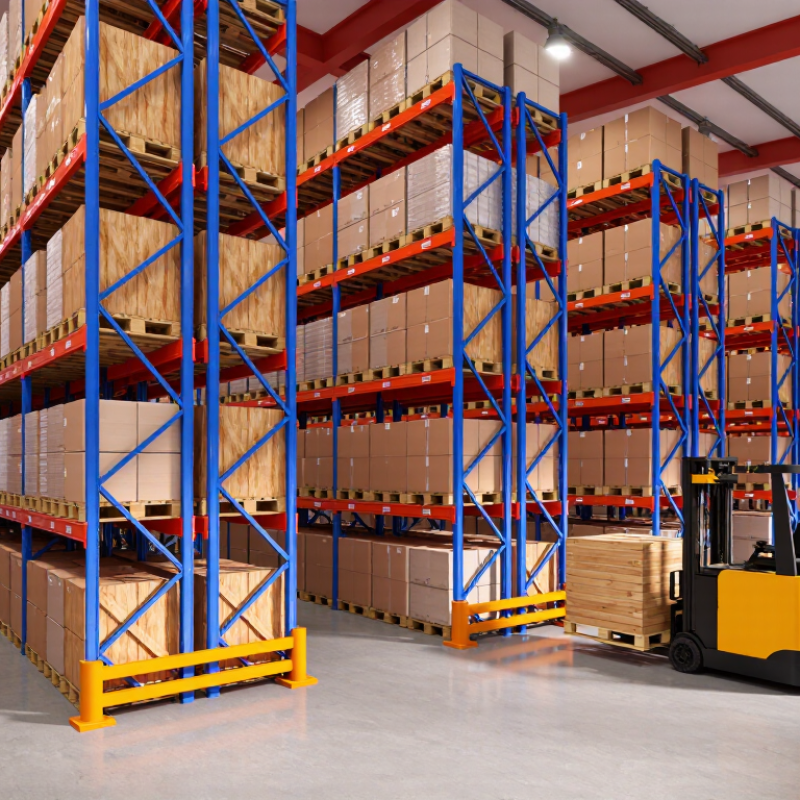
A pallet rack carries weight through a simple path: pallet to beams, beams to uprights, then uprights to the floor. Uprights are the perforated vertical frames; beams lock into them at selected heights. A forklift placing a pallet must leave it centered and fully supported. Uneven loading can change how forces reach the frame. Beam capacity depends on beam length, section, and load distribution, while frame capacity also depends on height and bracing. ANSI MH16.1-2023, published by the Rack Manufacturers Institute, sets design and testing requirements for steel storage racks. Ratings are configuration-specific. A label alone cannot describe every setup.
Aisle layout decides how easily trucks can turn, retrieve pallets, and avoid contact with rack frames. Selective racks offer direct access to each pallet, but wider aisles may reduce storage density. Measure the actual truck, load, and turning path before fixing aisle widths. MHI’s 2024 Annual Industry Report found that 55% of surveyed organizations planned to increase supply-chain technology investment within two years. Better inventory systems can help coordinate locations, but they do not increase a rack’s physical capacity. That detail is easy to miss. I would also recheck clearances after changing pallet sizes; small differences can matter.
For global buyers comparing pallet-rack manufacturers, the key question is not only how much a beam can hold. It is how the complete frame behaves under real loading conditions. EN 15512:2020 sets structural-design principles for adjustable pallet racking in Europe. ANSI MH16.1-2023 covers design, testing, and use of industrial steel storage racks in North America. They are not interchangeable checklists. Each uses its own assumptions, methods, and requirements, so a project’s governing standard should be agreed before drawings are approved.
MHI’s 2024 Annual Industry Report found that 55% of surveyed respondents planned to invest more than $1 million in supply-chain innovation over the following two years. That figure signals growing investment, not a rack-safety result. For rack design, ask for project-specific calculations covering loads, frame stability, connections, and site conditions. Check that the stated standard and edition match the calculation package. A tidy drawing is not enough. I have seen specifications look complete while omitting the actual pallet load or floor details.
Tips: Share pallet weight, dimensions, beam elevations, and forklift clearances early. Request the calculation basis and installation tolerances. If loads may change, say so; “standard pallet” can hide an important difference. The MHI report is useful context, but it cannot verify an individual rack design.
China’s top pallet-racking manufacturers serve varied warehouse needs, from selective racks for fast-moving cartons to drive-in systems for dense, uniform pallets. Many also supply pallet-flow lanes, shuttle-compatible structures, and mezzanines. Buyers should compare more than quoted capacity: steel specifications, beam-lock details, load-test records, seismic design assumptions, and clear installation drawings matter. A small mismatch can become an expensive site problem.
Grand View Research estimated the global warehouse-racking market at about US$9.3 billion in 2023, with projected growth through 2030. This is a market estimate, not a measure of Chinese exports. It does suggest broad demand for storage systems as distribution networks expand. UNCTAD’s Review of Maritime Transport 2024 reports that more than 80% of world trade by volume moves by sea, making export packaging and shipment planning practical concerns. Asian buyers may prioritize compact, high-density layouts; projects in the Middle East, Europe, and the Americas often require careful review of local design loads and installation conditions.
For global buyers comparing ten suppliers, assess product range alongside export readiness: container-friendly bundles, corrosion-resistant finishes, spare-part availability, and manuals that crews can follow on site. Ask for drawings and calculations tied to the actual building and pallet load. A catalogue alone is not proof of suitability. Forecasts also vary by research method, and supplier claims are not independently verified by market reports.
For global buyers comparing pallet rack types, storage density is only part of the decision. Selective racking gives each pallet a direct aisle-facing position, making picking and stock rotation straightforward. A forklift can reach a specific load without moving another one. That flexibility suits warehouses with many product lines or frequent order changes. The trade-off is wider aisle space and fewer pallet positions per square metre. Measure actual forklift turning needs, not just the dimensions on a layout drawing.
Drive-in racking reduces aisles by letting forklifts enter the rack structure. It can work well when many pallets hold the same product and batches move together. But deep lanes make access less flexible, and operators need clear entry points and careful handling. Double-deep racking places two pallets behind each other, increasing capacity without fully enclosing the forklift lane. It usually requires a reach truck and limits direct access to rear pallets. Small details matter. Check beam connections, upright thickness, load signs, and finish quality during supplier review. Ask for load calculations based on your pallet dimensions and floor conditions. A neat drawing is not enough. Buyers sometimes underestimate the cost of changing equipment or operating routines after installation; that deserves a second look.
For global buyers comparing pallet racking, verify the installed configuration, not just a catalogue’s headline capacity. Request the signed load schedule and check beam levels, bay widths, upright frames, anchors, and pallet dimensions against the actual layout. Loads change. A different beam height or uneven floor can affect capacity. Confirm that each load sign matches the configuration on site, and ask a qualified engineer to review any mismatch.
OSHA 1910.176(b) requires stored materials to remain stable against sliding or collapse; it does not provide rack load ratings or a universal clearance formula. Use it as a baseline, then check the applicable design standard and local fire and building requirements. Measure forklift turning space, load overhang, aisle width, sprinkler clearance, and flue spaces. Small details matter. A clearance that looks generous on a drawing may disappear when a pallet is damaged or a load shifts.
The BLS 2023 Census of Fatal Occupational Injuries recorded 1,942 fatal work injuries in transportation and warehousing. That figure is not rack-specific, but it underlines the value of disciplined site checks. Inspect for bent uprights, loose anchors, and missing safety locks; photograph damage and restrict access until assessed. A clean spreadsheet can still be wrong. I would recheck measurements after installation, because drawings and real floors do not always agree.
The pallet rests on beams, which transfer weight to the upright frames and then the floor. Keep the pallet centered and fully supported. Small misalignments can matter.
Beam length, beam section, load distribution, frame height, and bracing all affect capacity. Ratings apply to specific configurations, not every possible setup. Check the actual design.
Measure the forklift, loaded pallet, and turning path before setting aisle widths. A drawing alone may miss practical clearance needs. Recheck after pallet sizes change.
Each pallet is directly accessible from an aisle. This helps with varied products and frequent order changes, but wider aisles can reduce storage density.
It can suit large batches of the same product and reduce aisle space. Deep lanes limit access flexibility, so operators need clear entry points and careful handling.
Double-deep racking stores one pallet behind another. It adds positions without fully enclosing the forklift lane, but rear pallets are not directly accessible. A reach truck is usually needed.
No. Better inventory systems can help coordinate pallet locations, but they do not change the rack’s physical limits. Easy to overlook.
Review beam connections, upright thickness, finish, pallet dimensions, and floor conditions. Ask for load calculations for the planned setup. A neat drawing is not enough, and equipment changes may cost more than expected.
This guide explains how Pallet Racking systems support safe, efficient warehouse storage, from the roles of uprights and beams to load distribution and aisle planning. It introduces key design considerations addressed by EN 15512:2020 and ANSI MH16.1-2023, helping buyers understand how engineering requirements influence rack configuration and performance. The article also surveys ten leading manufacturers in China, with an overview of the products and export markets relevant to international buyers.
To help readers choose a suitable system, the guide compares selective, drive-in, and double-deep racking in terms of access, storage density, and operational needs. It also outlines practical checks for verifying load ratings, clearances, and installation conditions, and explains how safe material handling practices relate to OSHA 1910.176(b). Together, these topics offer a useful framework for evaluating options and planning a racking system that fits a warehouse’s inventory and workflow.